OA
Loading
Dubai — Tokyo
Loading
One key. The whole web. Any agent.
LLMLayer is one API that lets any AI agent reach the live web — search, scrape, crawl, map, extract, cited answers — for a fraction of what the incumbents charge.
Visit LLMLayer
A model with no web access is a genius locked in a room. Yassine built the door, and priced it so low nobody bothers building their own.
A model knows a lot. It also can't see what happened five minutes ago, and it can't read a page it was never trained on. So you hand it the web.
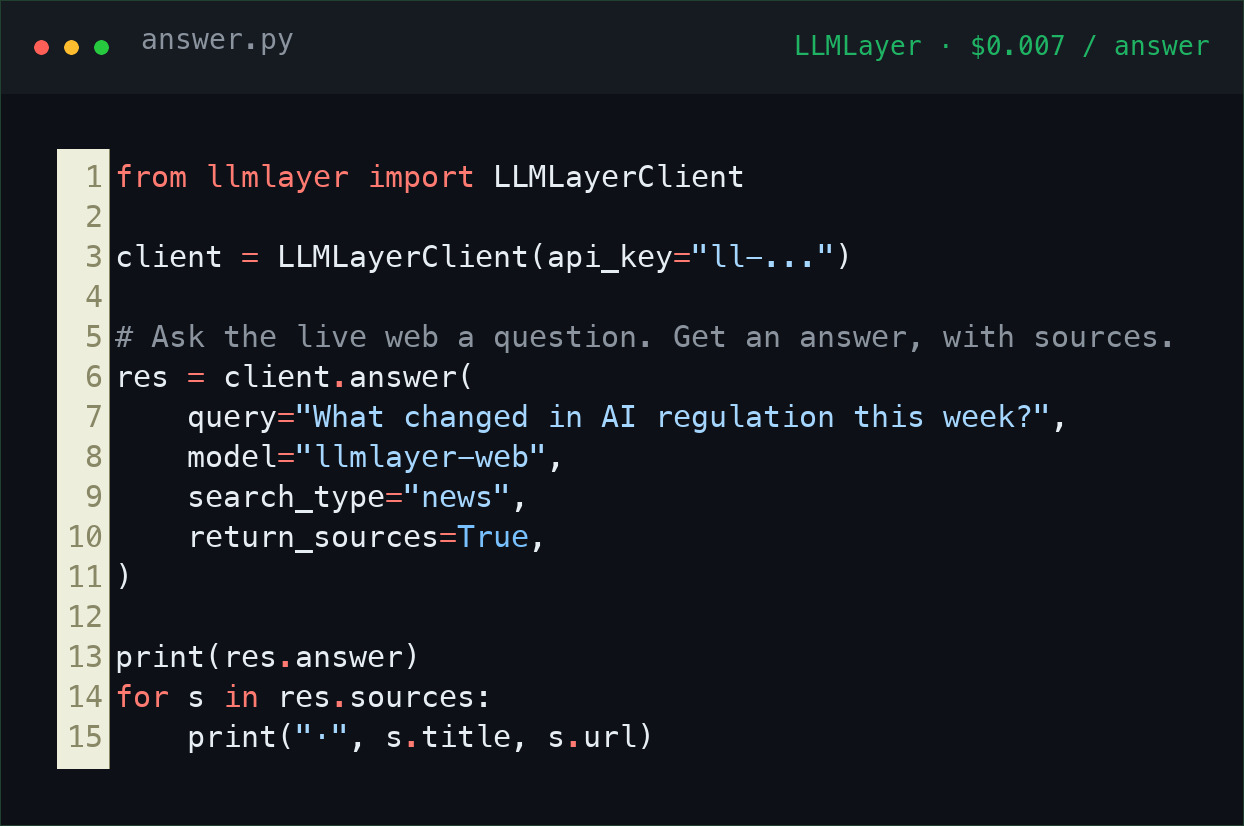
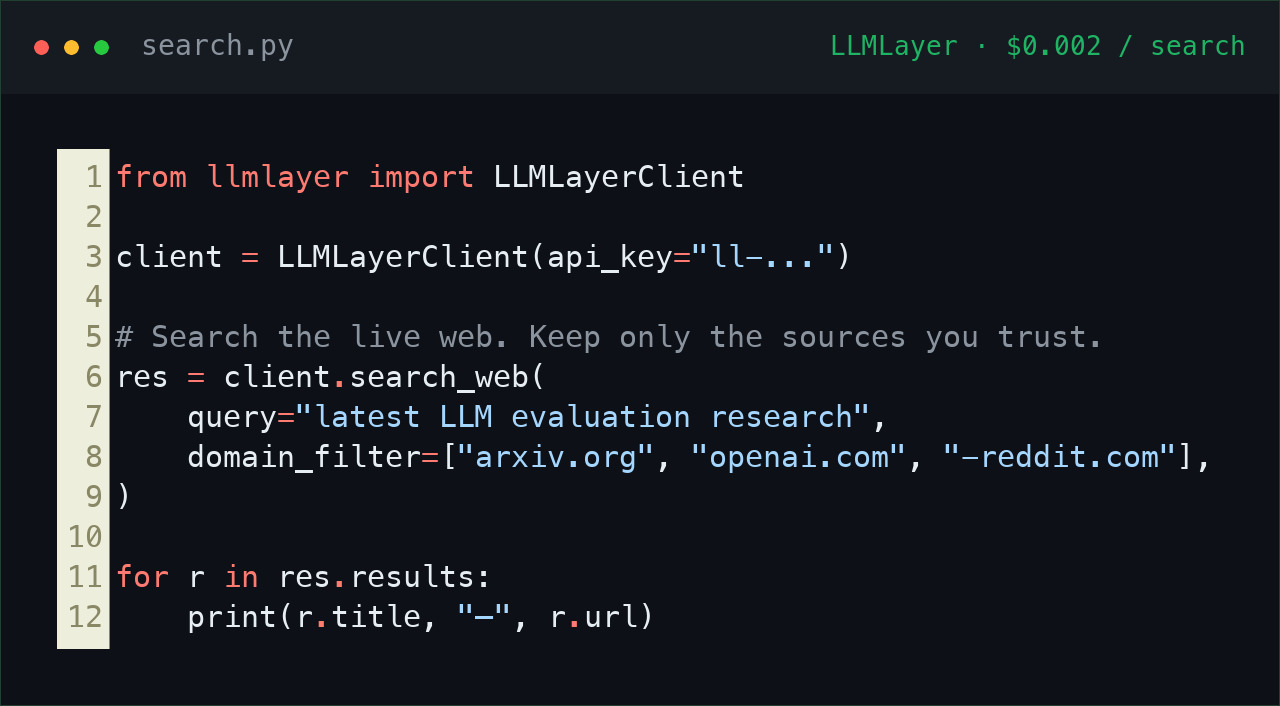
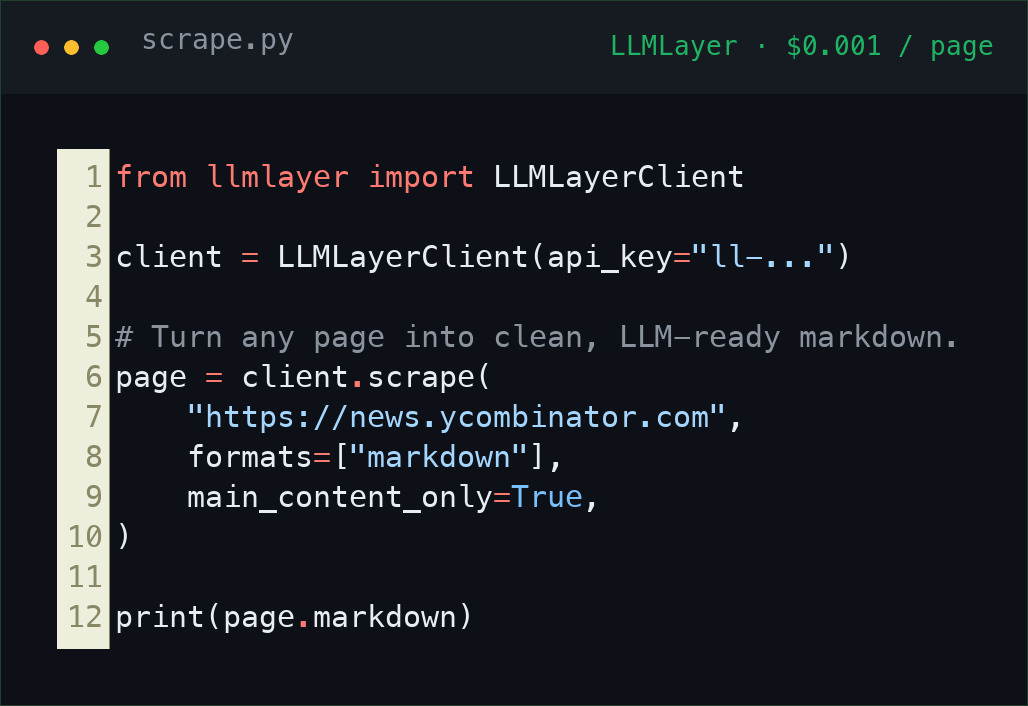
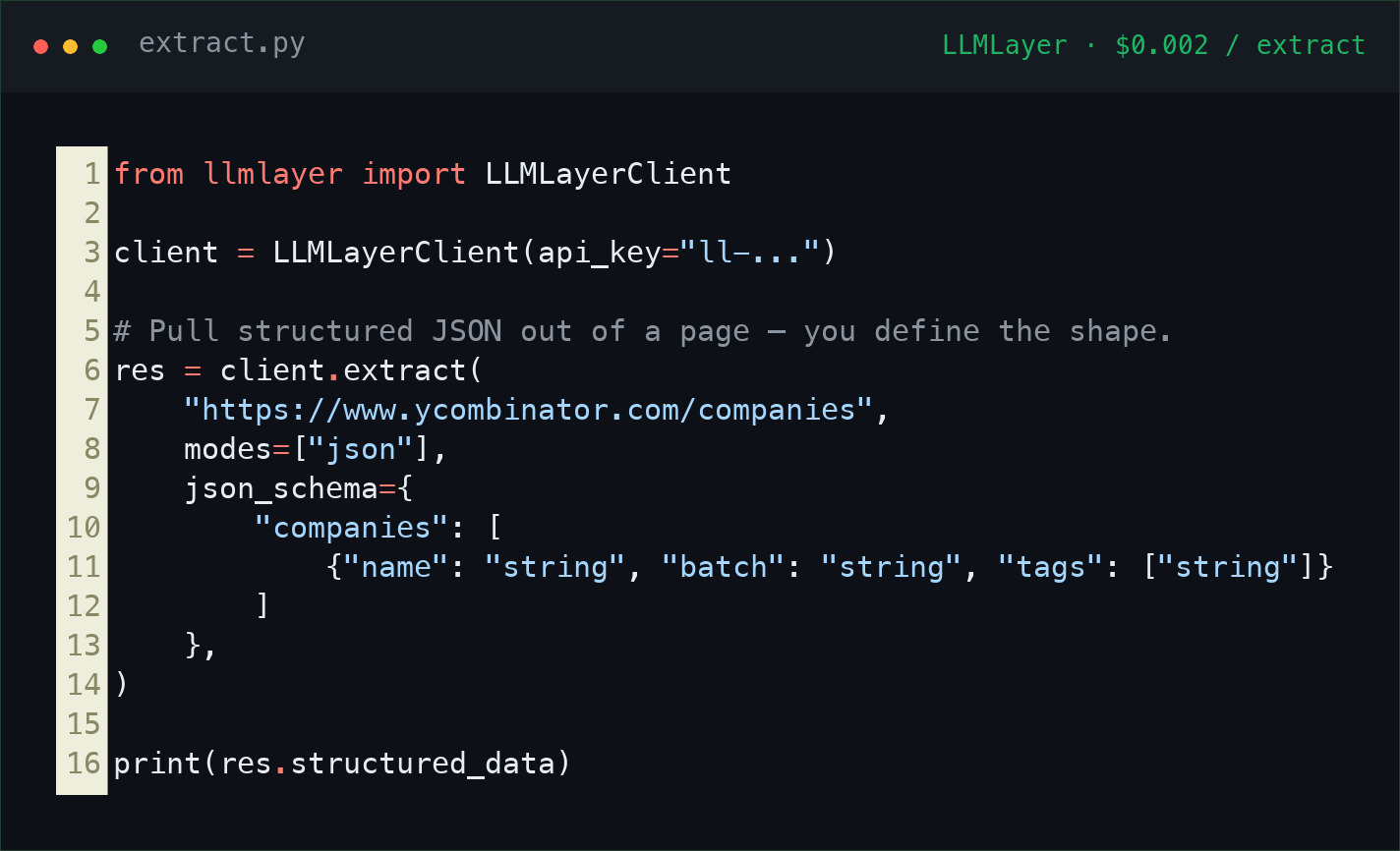
That's where the chore starts. You buy a search vendor. Then a scraper. Then a crawler. Then something to turn the mess into an answer. Four keys, four bills, four sets of docs you're reading at 1am. LLMLayer is all of it behind one key. Search a page. Scrape it into clean markdown. Crawl a site. Map five thousand URLs. Pull structured data out of anything. Get an answer with its sources attached. You pay for the calls you make, nothing else.
I back people, not decks. Yassine Khazzan taught himself AI through COVID on top of real engineering chops, shipped CeleritAI to paying users, then went all in on this. He's in Rabat. No co-founder, no fund behind him. Just shipping.
My job is the one I do in everything I build. I open doors and help raise the first funding — I don't write the check. I bring the hiring infrastructure, the network to reach the first serious developers, and the kind of blunt feedback that keeps a product simple. The product is his. The reach is mine to lend.
The model is the brain. The web is the world. LLMLayer is the wire between them.
Every serious agent needs that wire. We want it to be the boring, dependable default — the call you make without thinking, priced low enough that rolling your own is just a wasted weekend.
My thinking, plainly
Every AI agent needs the live web. Almost none can reach it without gluing four vendors together. LLMLayer is the one key that does the whole job, cheap.
An agent with no live web access is guessing. Fixing that today means a search vendor, a scraper, a crawler, and a model — four contracts, four bills, a day of wiring. LLMLayer does the whole job behind one key: search, scrape, crawl, map, extract, cited answers. Pay-as-you-go, credits never expire, priced well under the incumbents (the company markets a search at roughly $0.004 versus Perplexity, framed as ~80% cheaper). Every new agent makes web calls. The number of agents climbs every month. A thin fee on each call, on a rising tide of calls, is a real recurring business. The bet: own the default web call for agents, the way Stripe owns the default payment call.
Models got good. Their blind spot didn't move: they don't know what's happening now, and they can't read a page they never saw in training.
The fix is to hand the model a tool that fetches the live web. Here's what most people miss. It's one tool, not a category. Search, scrape, crawl, answer — those aren't four businesses. They're one need, give the agent the world, chopped into endpoints. The first company that treats them as one thing behind one key owns the primitive. The market still sells them apart, by different vendors, with different keys. That split is the opening.
Three things lined up.
Demand is here. The field is fragmented. Price is the lever. Good time to consolidate.
LLMLayer is a single API for everything an agent wants from the web.
It's model-agnostic on purpose, for developers who won't be locked to one vendor. Swap between GPT-5.1, Claude, DeepSeek, Llama and more (15+, per the company), or use LLMLayer's own flat-priced llmlayer-web and llmlayer-fast models. List prices: scrape $0.001 a page, search and extract and map $0.002, a cited answer $0.007. No subscription. Credits don't expire.
The wedge is price and simplicity. A developer who needs the web for their agent finds one key that does the whole job for a fraction of what gluing vendors together costs. Easy first yes.
The growth is volume. Each agent makes a lot of web calls. The number of agents keeps climbing. A thin fee on a rising tide of calls grows without selling the same customer twice.
The path runs in three moves. Start with indie developers and small teams, the ones who feel the price and the friction hardest. Grow with them as their agents hit production and call volume climbs. Then get baked into the frameworks and starter templates new builders copy from, so the default is set before anyone runs a price comparison.
The market number is an estimate, not a measurement. The broad AI-agents market is cited at roughly $8–12B in 2026 and growing fast. The slice this sits in — web access for agents — is plausibly $100M–$500M today and on the order of $1–3B by 2030 at category growth rates. Directional, not bottom-up. The point is the shape: a layer every agent touches, with usage that only goes up.
First edge: switching cost. Once an agent runs on one key for the whole web, ripping it out to reassemble four vendors is work nobody volunteers for. Boring and dependable keeps the customer.
Second edge: unit cost. Search, scrape, and answer under one roof means one stack to optimize instead of paying three vendors their margins. That funds a price a single-product rival can't match.
Third edge compounds. More calls means better caching and routing, which cut cost per call, which let the price drop, which win more calls. The lead widens on its own.
Yassine Khazzan is the founder, in Rabat. He taught himself AI during COVID on top of prior engineering work, then built CeleritAI — an open-source-Perplexity-style product with paying clients — before going all in here. He's already shipped the painful version of this once. He knows where the bodies are buried in web infrastructure.
My role is the one I bring to everything I build. I'm fundraising-in-chief: I open the doors and help raise the first funding, I don't put in the cash. I bring the hiring infrastructure to staff up fast, the network to reach the first serious users, and the guidance to keep the product sharp as it grows.
The target is the one I hold every venture to: breakeven with salaries paid, or first funding, within six months. No vanity. A business that pays for itself.
I'm betting web access becomes a standard call every agent makes, and the company that makes it the simplest and cheapest call becomes the default. One key, any model, the whole web, priced so low that building your own makes no sense. If that's right, LLMLayer isn't a feature. It's a piece of plumbing the agent economy runs through, and the volume takes care of the rest.
Hands-on, from zero. With singular people.